

Project Overview
OAsys: Speedbots Tournament is a fast-paced FPS runner on Unreal Engine 5 inspired by Ghostrunner and Neon White, developed as a graduation project at Objectif 3D Montpellier.
A team of 20 persons :
-
3 GD/LD
-
3 Animators
-
4 Graphic Designer 3D
-
1 Technical Artist
-
7 Programmers
-
1 Sound Designer
-
1 Musician
We've been developing OAsys for nearly a year, released on Steam in June 2025.
Key Contributions
-
Project Coordinator : GD/LD lead coordinating cross-team communication for consistent development flow.
-
Game Design : Implemented and refined the 3C (Camera, Character, Controls) throughout development, while establishing narrative design systems for immersive storytelling.
-
Level Design : Created 3 shipped game levels from initial whiteboxing to final engine implementation.
Project Coordination
May 2024 - Present
Department Leadership
• Took ownership of the Game Design/Level Design department, restructuring workflows to enhance team synergy and project clarity.
Process Innovation
• Introduced and implemented the R.A.C.I. matrix across the team, reducing role ambiguity and accelerating feature development.
• Established standardized documentation practices for design pipelines.
Collaboration Facilitation
• Orchestrated weekly syncs that improved cross-disciplinary transparency.
• Served as primary mediator for creative conflicts, fostering a psychologically safe environment for iteration.
Game Design
Player Mechanics
I focused on crafting a player experience that feels rewarding, fluid, and deeply engaging to master. With speed as a core pillar, we carefully balanced lightning-fast movement with intuitive accessibility.
Jump & Double Jump : I adopted a more horizontal jump arc to prioritize vertical gameplay elements (like Grapple hook or Secondary shoot of the SMG), creating intentional air control trade-offs.
Wallrun : Expands player movement options, enabling dynamic traversal and unlocking alternate pathways through the environment.
Slide : Lets players squeeze through narrow paths while maintaining high velocity, delivering both practical navigation and an exhilarating sense of speed.
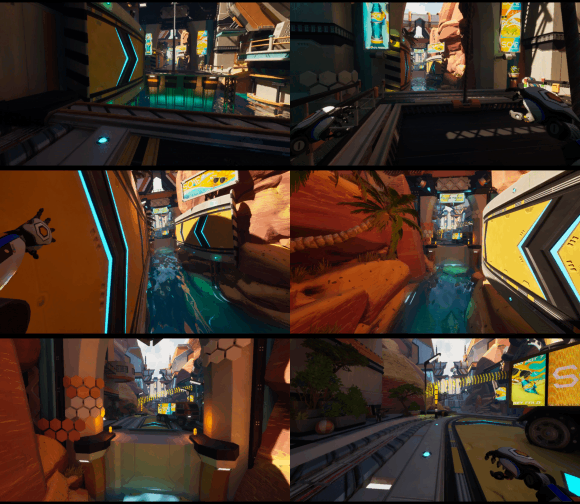

Character Movement Design : I designed the player character’s movement system to feel responsive and satisfying, drawing inspiration from high-speed titles like Ultrakill and Ghostrunner. Every input—from dashes to momentum preservation—was tuned to deliver that adrenaline-fueled “flow state” these games excel at. I make a Metrics Gym Level to detail the movement system.
Gameplay Elements
I contributed to designing the game's core gameplay elements to create a compelling and engaging player experience.
Grapple hook : The grapple hook fundamentally changes how players engage with the environment - by eliminating ground dependency, it introduces verticality as a core exploration dimension, encouraging aerial mastery and layered level navigation.
Turret : To create relentless forward momentum, I designed turrets that only hit stationary players - maintaining full speed grants perfect evasion, while stopping guarantees damage. This risk/reward loop:
-
Rewards flow → Players feel mastery when chaining moves at full velocity.
-
Punishes hesitation → Stops become tactical decisions rather than safe options.
-
Embodies our core pillar → "Never stop moving" as both mechanic and philosophy.
Glass : Staying true to our level design pillar of “The player creates their own path.” I wanted to foster the feeling of discovering unconventional routes. This led to the implementation of breakable glass throughout the levels – environmental elements that reward experimentation and create emergent shortcuts.
Oil Puddle : A speed killer. Getting stuck means certain death pushing players to replay, refine their routes, and master every inch of the level.
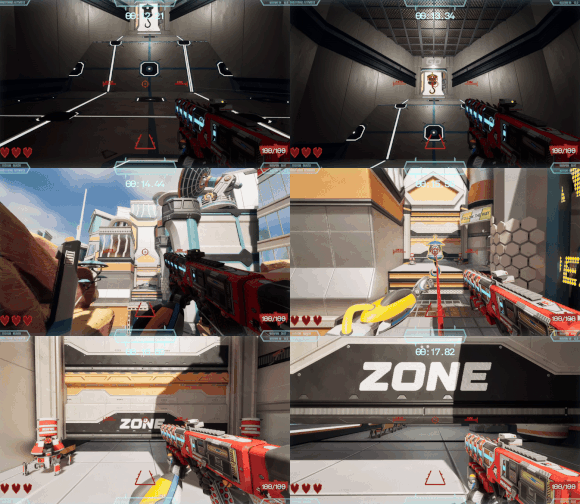

Level Design : Kalypso
Screenshots Overview


Level Overview
Kalyspo serves as OAsys second level, designed for players still learning core mechanics. At this stage, they encounter two new gameplay systems: primary and secondary fire modes.
I led this level's development from pre-production through final blockout in 3 weeks, collaborating closely with artists to highlight their work while maintaining strong level design principles.
Focus Area
-
Tutorial : The primary focus was teaching weapon mechanics through contextual scenarios, preparing players to apply these skills in later combat situations.
-
Curve Learning : This level introduces disruptive obstacles (oil puddles, turrets) to teach players their environment is hostile. Hazards punish recklessness but reward adaptive movement forcing players to engage intentionally with the space.
-
Learn the philosophy of OAsys : This level serves as a tutorial while remaining replayable players can return to beat their best score as their skills improve, creating a natural progression benchmark.
Process
The writing
First, I write to approach the level design literally, which helps me restructure my thoughts and constraints :
-
GOALS – What am I trying to achieve, why, and how?
-
ELEMENTS – What do I have at my disposal?
-
GAMEPLAY BEATS – What do I want the player to feel?
-
QUESTIONS – Questions I have and should answer later.
-
SEQUENCES – Things I’d like to include in the level
The map & Intensity curve
I first establish an overall intensity curve to map the player's intended stimulation rhythm. For Kalypso, this curve avoids sharp spikes, favoring a steadier learning progression.
I use Inkscape to create layout maps, plotting all gameplay elements and their positions to estimate the level’s scale and required workload."
Implementation & Iteration
I transition to the game engine for first playable iterations, immediately testing with both GD/LD peers and cross-discipline teams to gather feedback.
When players discover unintended paths, I embrace these emergent opportunities refining rather than removing them to enrich the level’s depth.


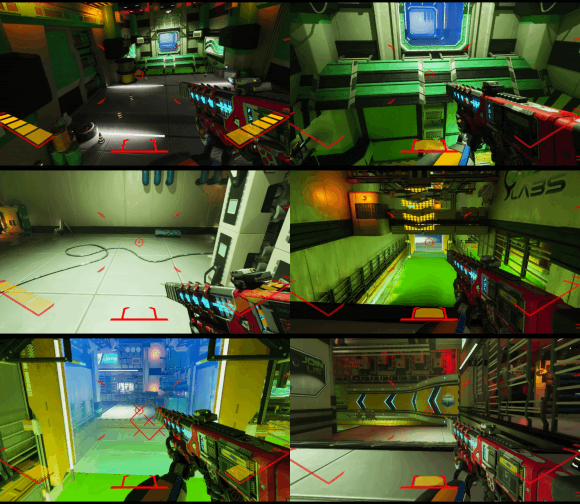
Level Design : GlassdeVerre
Screenshots Overview


Level Overview
GlassdeVerre serves as OAsys fourth level.
Set in and around an industrial factory, this level teaches players to leverage breakable glass as a core gameplay element shattering predefined paths to discover and create their own routes through emergent experimentation.
I led this level's development from pre-production through final blockout in 3 weeks, collaborating closely with artists to highlight their work while maintaining strong level design principles.
Focus Area
-
Learning Gameplay Element : GlassdeVerre's primary focus is introducing the breakable glass gameplay element that players will re-encounter in later levels, establishing it as a core mechanic through organic level design.
-
Improvise shortcuts : First-time players experience organic pathfinding freedom (grapple above or slide below ?) The choice is theirs. Replays then reveal hidden path optimizations, encouraging full exploration of the level’s time-saving potential.
-
Identify structural weaknesses : Teach players to navigate obstacles and through intuitive environmental cues, challenging them without frustration by ensuring every failure feels instructive and every success earned.
Process
Screenshots Overview
The writing
First, I write to approach the level design literally, which helps me restructure my thoughts and constraints :
-
GOALS – What am I trying to achieve, why, and how?
-
ELEMENTS – What do I have at my disposal?
-
GAMEPLAY BEATS – What do I want the player to feel?
-
QUESTIONS – Questions I have and should answer later.
-
SEQUENCES – Things I’d like to include in the level
The map & Intensity curve
I first establish an overall intensity curve to map the player's intended stimulation rhythm.
I designed three distinct paths in GlassdeVerre:
-
Main path : Highly visible and easiest to follow, but the longest route.
-
Shortcut : Less obvious, rewarding players with significant time savings.
-
Speedrun route : Nearly hidden, offering the fastest completion for prestigious medals.
I use Inkscape to create layout maps, plotting all gameplay elements and their positions to estimate the level’s scale and required workload."
Implementation & Iteration
I transition to the game engine for first playable iterations, immediately testing with both GD/LD peers and cross-discipline teams to gather feedback.
When players discover unintended paths, I embrace these emergent opportunities refining rather than removing them to enrich the level’s depth.
